Low end
$2,000
Typical range
$2,000 - $7,000
High end
$7,000+
What Carbon Fiber Straps Are and How They Work
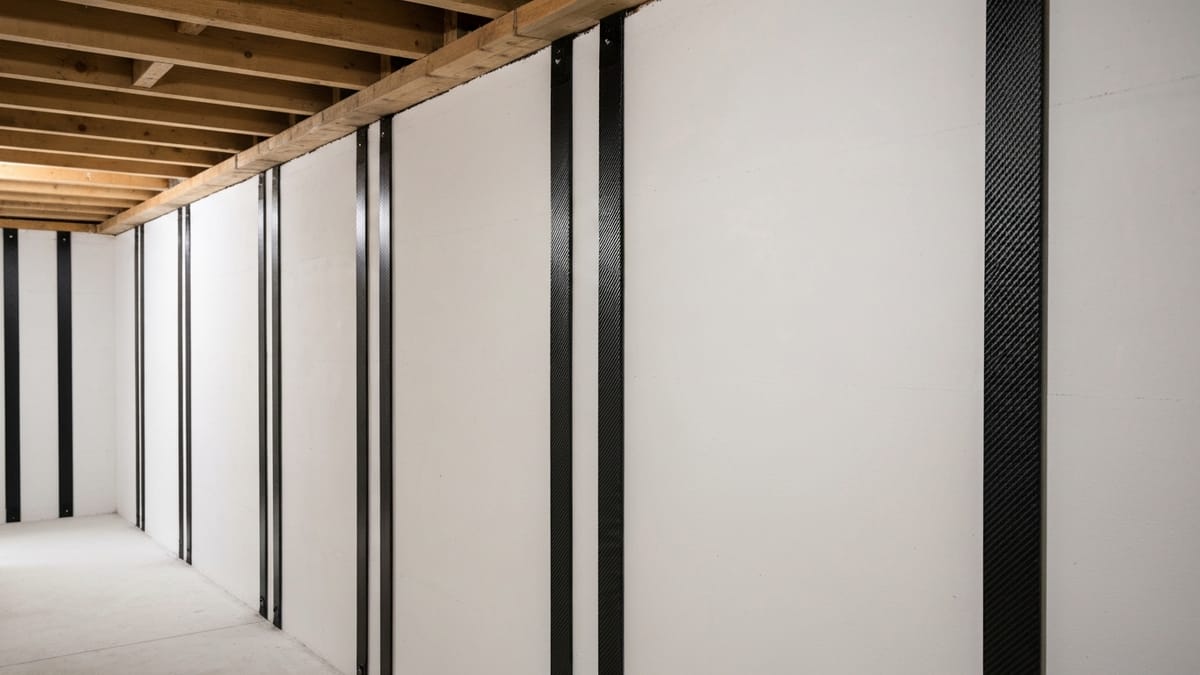
Carbon fiber is one of the strongest materials available relative to its weight. In foundation repair, carbon fiber straps are woven or unidirectional strips of carbon fiber fabric that are bonded to the interior face of a bowing basement wall using a two-part structural epoxy.
The strap runs floor-to-ceiling, anchored at the slab (resisting the toe of the wall from moving in) and at the floor framing above (resisting the top). The carbon fiber in tension prevents the wall from deflecting further inward under soil pressure.
The system is passive - it doesn’t actively correct existing bow, but it holds the wall in its current position against ongoing lateral pressure.
Cost Breakdown
Per-Strap Cost
| Component | Approximate Cost |
|---|---|
| Carbon fiber material (per strap) | $100-$200 |
| Structural epoxy (per strap) | $50-$100 |
| Labor (installation and surface prep) | $200-$500 per strap |
| Installed total per strap | $400-$900 |
What Drives Cost Up
Wall length and strap count: The primary variable. More affected wall = more straps.
Surface preparation: The wall face must be clean, dry, and structurally sound. Significant spalling, staining, previous coatings, or surface deterioration requires prep before bonding - this adds cost.
Waterproofing done simultaneously: Many homeowners address water intrusion at the same time as carbon fiber installation. Interior drain tile + sump pump + carbon fiber straps is a common combined project - but adds cost.
Finished space: If the basement is finished, drywall or framing must be removed to access the wall. Removal and patching adds cost (sometimes billed separately by a GC).
Local labor rates: Foundation repair pricing varies regionally. Expect higher rates in the Northeast and Pacific Coast; more competitive pricing in the South and Midwest.
Project Cost Scenarios
| Wall Length / Conditions | Straps | Estimated Cost |
|---|---|---|
| 20-foot wall, moderate bow | 4-5 | $2,000-$4,500 |
| 30-foot wall, moderate bow | 5-7 | $2,500-$6,000 |
| Full basement perimeter (3 walls) | 12-18 | $6,000-$15,000 |
| Combined with interior drain tile | - | Add $5,000-$12,000 |
Carbon Fiber Straps vs. Alternatives
| Method | Cost Range | Corrects Existing Bow? | Exterior Access Needed? |
|---|---|---|---|
| Carbon fiber straps | $2,000-$7,000 | No - prevents further movement | No |
| Wall anchors | $5,000-$16,000 | Yes - gradual correction over time | Yes (anchor plate in yard) |
| Steel I-beams | $3,000-$12,000 | Partially - can push wall back | No |
| Exterior excavation + repair | $15,000-$40,000 | Yes | Yes (full excavation) |
Choose carbon fiber when:
- Bow is under 2 inches
- The goal is to stop further movement, not correct existing bow
- You want minimal disruption (no excavation, no yard anchor plates)
- Budget is a priority compared to wall anchors
Choose wall anchors when:
- You want to gradually correct the existing bow over time
- Bow is between 1-3 inches
- You have yard access for the anchor plate
Choose steel I-beams when:
- Bow is more significant (2+ inches)
- You want immediate rigid bracing
- Yard access is unavailable for wall anchors
What to Look for in a Carbon Fiber Strap Quote
A complete quote should specify:
- Number of straps and their placement spacing
- Strap width (typically 4” or 6” - wider provides more resistance)
- Epoxy system to be used (brand and product matters - verify it’s a structural-grade, two-part epoxy)
- Wall prep included or excluded
- Anchor detail at top and bottom
- Warranty - most manufacturers offer 25-year or lifetime warranties on materials; verify the contractor’s labor warranty
Ask whether the strap system is engineered for your specific wall dimensions and soil loading, or is it a one-size-fits-all installation. Reputable contractors will specify strap count and spacing based on wall assessment, not just wall length.
When to Get a Structural Engineer Opinion First
If your wall is bowing and you’re not sure whether carbon fiber is sufficient, an independent structural engineer assessment ($300-$700) can give you an unbiased opinion on:
- How much bow is present (measured, not estimated)
- Whether carbon fiber is structurally adequate for your situation
- How your situation compares to the limits of this repair method
This is particularly valuable if you’re comparing a carbon fiber proposal from one contractor to a wall anchor proposal from another - they may be recommending different solutions because one is genuinely more appropriate, or because they happen to offer different products.
How to Tell If Your Wall Qualifies for Carbon Fiber
Carbon fiber is the right tool only inside a specific window. Before you accept a strap-only proposal, confirm your wall fits these conditions:
- Deflection under 2 inches: Measure the maximum inward bow at the middle of the wall against a straight vertical line (a plumb line or a long straightedge). Under about 2 inches is the working range for carbon fiber. Beyond that, wall anchors or steel beams are usually the better call.
- No rotation at the base: The wall should be bowing at the midpoint, not tipping in at the bottom or sliding off the footing. If the base has rotated or shifted, the toe of the wall is no longer held, and a strap anchored to the slab alone cannot fix that.
- Sound wall material: The block or poured concrete needs enough intact strength to bond to and to carry load. A wall that is crumbling, badly spalled, or sheared through is a different repair.
- The cause is lateral soil pressure: Carbon fiber resists the horizontal push from soil and water. It is a good match for hydrostatic pressure and expansive clay against the wall. It is not a fix for settlement, where the footing itself is dropping.
If any of these is in doubt, get a structural foundation repair assessment before committing. For the broader picture on what causes this movement, see bowing basement walls.
Step-by-Step: How Carbon Fiber Straps Are Installed
Knowing the process helps you judge whether a quote covers real work or cuts corners.
- Assess and mark layout. The contractor measures the wall, confirms deflection is in range, and marks strap positions based on spacing and load, not just even spacing for looks.
- Prep the wall surface. Each strap path is ground down to clean, sound concrete or block. Paint, sealer, dust, and laitance are removed so the epoxy bonds to the substrate, not a coating. This step is where most bad installs fail.
- Cut a top and bottom anchor detail. The top is tied into the floor framing or sill area and the bottom is anchored at or into the slab, so the strap resists movement at both ends rather than just spanning open.
- Mix and apply structural epoxy. A two-part epoxy is mixed at the correct ratio and troweled onto the prepped path.
- Bond the carbon fiber. The strap is pressed into the epoxy and rolled out to remove air voids and force full contact. Voids are weak points, so this rolling matters.
- Anchor the ends. Top and bottom terminations are set into their anchor details and saturated with epoxy.
- Cure. The epoxy cures, typically 24-48 hours, before the wall is considered loaded. The straps can then be painted.
A crew can usually install 4-8 straps in a day. The cure time runs after that, so plan for the wall to be finished a day or two later.
How Many Straps and What Spacing: Worked Examples
Straps are spaced roughly every 4-6 feet along the affected section, tighter where the bow or load is worse. Use 4 feet on center for heavily loaded or more deflected walls and up to 6 feet for lighter cases. The table below assumes a strap near each end of the run.
| Affected Wall Length | Straps at 6 ft Spacing | Straps at 4 ft Spacing |
|---|---|---|
| 12 ft | 3 | 4 |
| 16 ft | 4 | 5 |
| 20 ft | 4-5 | 6 |
| 24 ft | 5 | 7 |
| 30 ft | 6 | 8 |
| 40 ft | 8 | 11 |
Worked example, 20-foot wall at 6 feet on center: place a strap near each end and fill the middle at even intervals. Twenty feet divided by 6 feet is about 3.3 bays, so you land on 4-5 straps. At 4 feet on center the same wall needs 6 straps. A contractor should show you which spacing they chose and why, based on measured bow and soil loading, not a flat rule.
DIY Kits vs. Professional Installation
You can buy carbon fiber kits online for roughly $10-$60 per strap in materials. Against $400-$900 per strap installed, the gap is almost all skilled labor, surface prep, and the anchor detail, which is exactly where the repair succeeds or fails.
DIY is risky on a structural wall for concrete reasons:
- Surface prep is unforgiving. If the strap bonds to old paint or dusty block instead of sound concrete, it can peel under load.
- Anchoring is the hard part. A strap that is simply glued top to bottom without a proper slab and framing anchor can let the wall keep moving while it looks repaired.
- Voids are hidden. Air trapped under the strap creates weak spots you cannot see once it cures.
- No engineered spacing. A kit does not tell you how many straps your specific wall and soil load require.
- Warranty loss. Manufacturer material warranties generally require certified installation, so a DIY job usually voids them.
DIY carbon fiber can be reasonable for reinforcing a minor non-structural crack. For a bowing structural basement wall, the failure mode of a bad self-install is the wall you were trying to save, which makes professional installation the safer spend.
Warranty: Materials vs. Labor
Carbon fiber warranties come in two parts, and homeowners often confuse them:
- Material warranty: Manufacturers commonly offer a 25-year or lifetime warranty on the carbon fiber and epoxy system itself. This covers the product, not the person who installed it.
- Labor warranty: The contractor’s own guarantee on workmanship, usually shorter, sometimes 5-10 years, sometimes transferable to a new owner. This is the one that actually pays if the install fails.
Ask three questions: what does the labor warranty cover, how long does it last, and is it transferable if you sell the house. A lifetime material warranty means little if the contractor’s labor coverage is thin or the company may not be around to honor it.
Signs the Straps Are Failing or the Wall Is Still Moving
Carbon fiber should hold the wall permanently, but you still want to watch for trouble:
- New or widening cracks near a strap or between straps
- A strap edge lifting, peeling, or bubbling away from the wall
- Fresh horizontal cracking in the block, which signals ongoing bending pressure
- Measurable increase in bow when you re-check the wall against a plumb line
- Doors or windows above the wall sticking or shifting after repair
The most useful habit is a baseline. After install, mark the maximum bow and the date, then re-measure once or twice a year. If the number holds, the system is doing its job. If it grows, the load may exceed what straps can carry, and you are back to considering wall anchors or steel bracing. Ongoing movement is not always a strap defect, it can mean the wall needed a stronger method from the start.
Maintenance
Maintenance is essentially none. Cured carbon fiber does not rust, rot, or corrode, and there are no fasteners to retension. Keep managing water and soil outside the wall, since straps hold the wall but do not remove the pressure causing the bow, and keep an eye on your bow measurement. That is the whole maintenance program.
Carbon Fiber for Cracks vs. Bowing
The same material solves two different problems:
- Bowing walls: Full-height vertical straps spaced across the wall resist the inward push over the entire span. This is the main use and the one that drives the $2,000-$7,000 project cost.
- Isolated cracks: After the crack is sealed, a shorter carbon fiber patch or stitch bonded across it keeps it from widening. This is a much smaller job, often part of crack repair rather than a full wall system.
The trap is a horizontal crack in a block wall. That is a sign of bending, not a simple crack, so it is treated as a bowing repair with full vertical straps, not a single patch. When in doubt, size the fix to the cause, not to the crack you can see.
For pricing and how to choose between them, see the wall anchor cost guide and the side-by-side wall anchors vs. carbon fiber straps comparison.