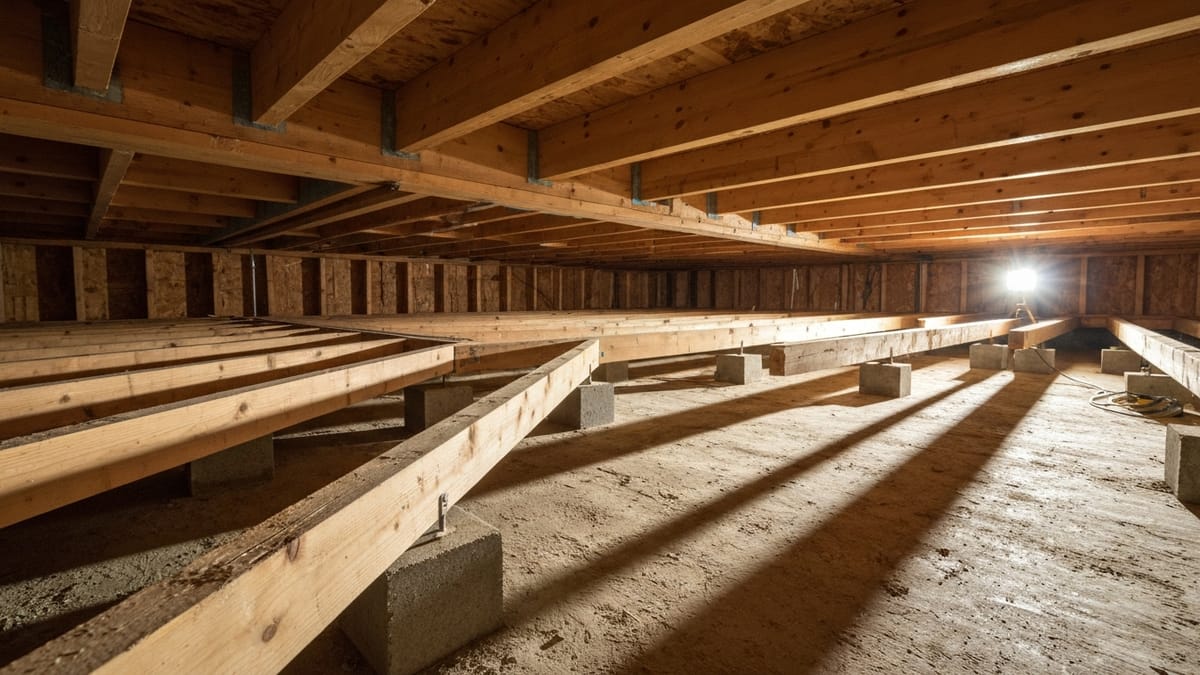
What Is a Pier and Beam Foundation?
A pier and beam (also called post and beam) foundation elevates the structure above grade on a series of vertical piers - historically made from wood posts, concrete, or masonry - that support horizontal beams (girders). The beams in turn support the floor joists. The space between the ground and the floor is the crawlspace.
This foundation type is common in:
- The South and Gulf Coast (Texas, Louisiana, Mississippi, Alabama) where it developed as a practical response to warm, humid climates and expansive soils
- Older Northeastern and Midwestern homes built before slab construction became standard
- Hillside and sloped-lot construction where grade changes make a crawlspace more practical than a slab
For a side-by-side look at how pier and beam compares to slab foundations, including maintenance needs and repair approaches, review the foundation type comparison.
Signs a Pier and Beam Foundation Needs Repair
Because most of the structure sits out of sight in the crawlspace, the earliest signals usually show up inside the living space. Watch for these:
- Bouncy or springy floors that flex when you walk across them, especially in the middle of a room. This points to beams or joists that are deflecting more than they should, often from undersized framing, wide pier spacing, or early rot.
- Sloping or uneven floors. Drop a marble and watch it roll, or check with a level. A consistent slope toward one corner usually means piers under that area have settled. For a fuller breakdown of causes and diagnosis, see the guide on uneven floors.
- Gaps at the trim and baseboards, or gaps opening between floorboards, as the floor system shifts away from level.
- Sticking doors and windows that bind in their frames. When the floor tilts, door and window openings rack out of square. The pattern is covered in more detail under sticking doors and windows.
- Cracked, crumbling, or leaning piers visible from inside the crawlspace, or piers that have separated from the beam they are meant to support.
- Musty odors and visible moisture in the crawlspace, standing water after rain, or condensation on the underside of the floor. These conditions drive the wood rot described below.
- Soft or spongy beams and joists that give when pressed, or that show fungal staining and insect galleries. Damage here is often tracked as floor joist damage.
Any one of these is worth an inspection. Two or more together usually means active movement or moisture that should be addressed before it spreads.
Why Pier and Beam Foundations Fail
Moisture in the Crawlspace
The crawlspace environment is the primary threat to pier and beam foundations. Ground moisture evaporates upward, saturating the wood components. Over time, chronic moisture causes:
- Wood rot in floor joists, beams, and wooden piers
- Mold growth that can affect air quality in the living space
- Pest attraction - termites, carpenter ants, and rodents thrive in damp, dark crawlspaces
- Insulation degradation if batt insulation is used in the floor cavity
Solution: Crawlspace encapsulation and vapor barrier installation to control moisture at the source.
Pier Settlement
Concrete block piers and poured concrete piers can settle as the soil beneath them compresses or erodes. Individual piers sinking at different rates creates differential movement - the floor tilts, doors stick, and cracks appear in interior finishes.
Solution: Shimming settled piers back to level, or replacing individual piers with deeper-set concrete or steel piering.
Insufficient Original Construction
Many older pier and beam homes were built with fewer piers than would be specified today, or with undersized beams. This isn’t necessarily a crisis - it can mean the floor has always had slight flex - but it does mean the system is more susceptible to problems as it ages.
Solution: Adding mid-span support piers and/or sistering additional joists or beams.
Wood Rot and Insect Damage
Termites specifically target the concealed wood components in crawlspaces. By the time visible damage is apparent, termite colonies may have been active for years. Wood rot from moisture can occur without any pest involvement.
Solution: Replace damaged beams and joists; treat for pests before structural work. Most foundation contractors coordinate with pest control companies for this sequence.
Pier and Beam Repair Methods
Pier Shimming and Replacement
The least invasive repair: shimming settles piers back to level using hardwood shims or steel shim plates. Works when the pier itself is sound but has shifted or settled slightly.
When piers are cracked, crumbled, or sunken significantly, replacement is required. Options:
- Concrete block stacking - traditional, cost-effective, but requires stable sub-soil
- Poured concrete piers - more durable, poured in forms to a consistent depth
- Steel piers / adjustable column jacks - allows future adjustment if movement continues; used in some markets for the perimeter
Cost: $250-$600 per pier replaced, depending on access and pier type.
Beam Sistering and Replacement
When floor beams (girders) or joists are damaged, rot-compromised, or undersized, contractors sister new lumber alongside the damaged member or replace it entirely. Sistering is preferred when the original member has some structural integrity remaining - it’s less disruptive than full replacement.
Cost: $50-$150 per linear foot for sistering; full beam replacement at $200-$400 per beam depending on size and access.
Crawlspace Vapor Barrier and Encapsulation
A vapor barrier (6-20 mil polyethylene sheeting) covers the ground surface to block moisture evaporation. Full encapsulation seals the crawlspace walls as well, converting it to a conditioned or semi-conditioned space.
Encapsulation is frequently recommended alongside structural repair because without moisture control, repaired wood components are at risk of re-deteriorating.
Cost: $1,500-$8,000 depending on crawlspace size and scope of encapsulation.
Adding Support Piers and Pads
When the original foundation has inadequate pier spacing, mid-span support piers are added beneath beams that are carrying more load than they can handle without excessive deflection. This tightens up a bouncy floor and eliminates long-term risk of further sag. New interior piers are commonly set on poured concrete pads or footings so the added load has a stable base and does not simply settle again.
Cost: $300-$700 per added pier.
Girder and Beam Replacement
The girders, sometimes called carrying beams, run beneath the joists and transfer their load down to the piers. When a girder is split, sagging, or rotted through, sistering may not be enough and the full member has to come out. Contractors temporarily jack and crib the floor above, remove the failed girder, and set a new pressure-treated or engineered beam in its place. This is more involved than pier work because the load path has to be supported the entire time.
Cost: $200-$400 per beam for straightforward replacement, rising to $1,000 or more for long spans, difficult access, or engineered lumber.
Sistering or Replacing Floor Joists
Individual joists that are cracked, notched too deeply, or softened by rot get a matching joist bolted alongside, called sistering, so the pair shares the load. Where a joist is too far gone, it is cut out and replaced. Sistering is the go-to fix when the original joist still holds some strength and the goal is to stop deflection without tearing out the floor above. Related structural symptoms and repair choices are covered under floor joist damage.
Cost: $50-$150 per linear foot for sistering; $150-$400 per joist for cut-and-replace, depending on access.
Addressing Crawlspace Moisture and Rot
Structural repairs do not last if the conditions that caused the damage remain. A wet crawlspace keeps feeding rot into new lumber. A durable repair pairs the framing work with moisture control: a ground vapor barrier, grading and drainage corrections so water flows away from the piers, sealing of foundation vents in many climates, and often a dehumidifier. Full crawl space encapsulation takes this further by lining the walls and floor and conditioning the space, which protects the wood you just paid to repair.
Cost: $1,500-$8,000 depending on crawlspace size and how far the encapsulation goes.
Helical or Concrete Piers for Perimeter Settlement
When the perimeter foundation or exterior grade beam has settled, surface shimming is not enough because the problem is in the soil, not the pier. In these cases contractors drive helical piers or push piers down to load-bearing strata, then transfer the perimeter load onto them and lift the settled section back toward level. Helical piers screw into the ground and can be loaded immediately, which suits pier and beam perimeters and lighter loads. Deeper poured concrete piers are an alternative where soils allow. See the dedicated helical piers service page for how this method works and when it fits.
Cost: $1,200-$3,000 per pier installed, driven mainly by depth to stable soil.
Cost Overview
| Repair Type | Typical Range |
|---|---|
| Individual pier shimming | $150 - $400 |
| Individual pier replacement | $250 - $600 |
| Beam sistering (per beam) | $200 - $600 |
| Adding mid-span piers (per pier) | $300 - $700 |
| Crawlspace vapor barrier | $500 - $2,500 |
| Full crawlspace encapsulation | $2,000 - $8,000 |
| Girder / carrying beam replacement | $200 - $1,000+ |
| Floor joist replacement (per joist) | $150 - $400 |
| Helical or concrete perimeter pier (per pier) | $1,200 - $3,000 |
| Full-house releveling (structural + moisture) | $5,000 - $15,000 |
For a deeper breakdown of pricing by scope and region, along with what drives a quote up or down, see the pier and beam foundation repair cost guide.
Cost Ranges by Scope of Work
The single most useful way to think about cost is by how much of the foundation the work touches. Three broad tiers cover most jobs:
- Minor shimming and spot repair, roughly $1,500 to $3,000. A handful of settled piers are shimmed or reset, maybe one soft joist is sistered, and a basic vapor barrier goes down. This is the common outcome when a problem is caught early.
- Partial repair with new piers, roughly $3,000 to $8,000. Several piers are replaced, mid-span support piers are added under bouncy floors, a beam or two is sistered or replaced, and moisture control is improved. This tier covers most homes that have gone a decade or more without attention.
- Full releveling and remediation, roughly $8,000 to $15,000 and up. The whole floor system is lifted back toward level, many piers are replaced, rotted beams and joists are rebuilt, and the crawlspace is fully encapsulated. Perimeter helical piers push the top of this range higher.
Where a home lands depends on how many piers move, how much wood has rotted, crawlspace clearance and access, and local labor rates.
The Repair Process Step by Step
- Inspection and diagnosis. A technician enters the crawlspace with a level and light, maps which piers have settled and by how much, checks beams and joists for rot and insect damage, and notes moisture sources. Laser or water-level readings record the starting elevations.
- Scope and estimate. The contractor lays out which piers get shimmed versus replaced, which beams or joists need sistering, and whether moisture control or perimeter piering is required, with a written estimate for each item.
- Pest and rot treatment first. If termites or active rot are present, treatment and removal of compromised wood come before new structural members go in, so repairs are not built onto failing material.
- Support and lift. Temporary jacks and cribbing take the load off the section being worked on. Settled areas are raised slowly, often over more than one visit, to avoid cracking finishes above.
- Structural repair. Piers are shimmed, replaced, or added; beams and joists are sistered or replaced; new piers are set on pads or footings.
- Moisture control. A vapor barrier is installed, drainage and grading are corrected, vents are handled per climate, and encapsulation is completed where specified.
- Final leveling and readings. The floor is brought to the agreed target and the contractor records after readings showing the correction achieved.
How Long It Takes
Timelines track closely with scope:
- Shimming or single pier replacement: about 1 day.
- Multiple piers plus some beam or joist work and basic moisture control: 3 to 7 days.
- Full releveling with encapsulation: 1 to 2 weeks, and longer on large homes or where extensive rot is found once the crawlspace is opened up.
Weather rarely stops crawlspace work, but heavy standing water may need pumping and drying before framing repairs can begin.
Pier and Beam vs Slab: A Quick Comparison
Pier and beam and slab foundations fail for different reasons and repair differently. Pier and beam keeps plumbing and wiring accessible under the floor and lets crews reach and replace individual members, but its wood components need ongoing moisture and pest management. Slabs have little wood to rot and less routine upkeep, yet a failed slab is harder to access and often needs underpinning or interior tunneling. For a full side-by-side on lifespan, maintenance, and repair cost, see slab vs pier and beam.
Crawlspace Maintenance to Prevent Recurrence
Most pier and beam repairs are, at root, moisture problems that were allowed to run. Keeping the repair intact comes down to keeping the crawlspace dry:
- Keep a ground vapor barrier in place and check that it stays sealed and unpunctured.
- Grade soil so it slopes away from the foundation, and keep gutters and downspouts carrying roof water well past the perimeter.
- Fix plumbing leaks under the house quickly; a slow drip can keep a section of framing wet for years.
- Run a dehumidifier or maintain encapsulation so relative humidity stays low enough that rot and mold cannot take hold.
- Inspect the crawlspace, or have it inspected, every couple of years and after any major storm or plumbing event.
Building this into a broader routine is easier alongside a preventive foundation maintenance schedule that covers drainage and grading around the whole home.
How to Choose a Contractor
Pier and beam work rewards experience, since much of the diagnosis happens by feel in a tight crawlspace. When comparing contractors:
- Confirm they specialize in pier and beam and crawlspace work, not only slab or basement repair.
- Ask for before and after level readings in writing, so the correction is measurable rather than a matter of opinion.
- Get an itemized estimate that separates structural repair from moisture work, so you can see what you are paying for.
- Check that they carry insurance and offer a written warranty, and ask whether it is transferable if you sell.
- Get more than one quote for anything beyond a minor job, and be wary of a bid far below the others, which often signals skipped moisture control or undersized repairs.
For structural jobs, an independent structural engineer or foundation repair company assessment can confirm scope before you commit to a large spend.
What to Expect During Repair
Contractors will access the crawlspace via the existing access hatch (usually in a closet, hallway, or exterior). Work is confined beneath the floor - the home is livable throughout most repairs. In cases requiring significant joist replacement, some flooring may need to be removed from above.
Contractors should provide before-and-after laser level readings showing the degree of correction achieved.
When to Get a Crawlspace Inspection
If you haven’t had a crawlspace inspection in the last 5 years - or if you’re seeing any of the symptoms above - get one. Crawlspace problems that are caught early are significantly less expensive to address. A full visual inspection typically costs $200-$400 and takes 1-2 hours.
Related Guides
- Pier and beam foundation repair cost
- Slab vs pier and beam
- Floor joist damage
- Uneven floors
- Crawl space encapsulation
- Helical piers