Low end
$500
Typical range
$500 - $12,000
High end
$12,000+
Why Retaining Walls Fail
A retaining wall holds back soil, and soil is heavy. When that soil is dry it presses against the wall with a manageable, predictable load. When it gets wet, everything changes. Saturated soil weighs far more and exerts hydrostatic pressure, a lateral push that builds up behind the wall and has nowhere to go. That pressure is what makes walls lean, bulge, crack, and eventually fail.
The common failure modes all trace back to the same handful of causes:
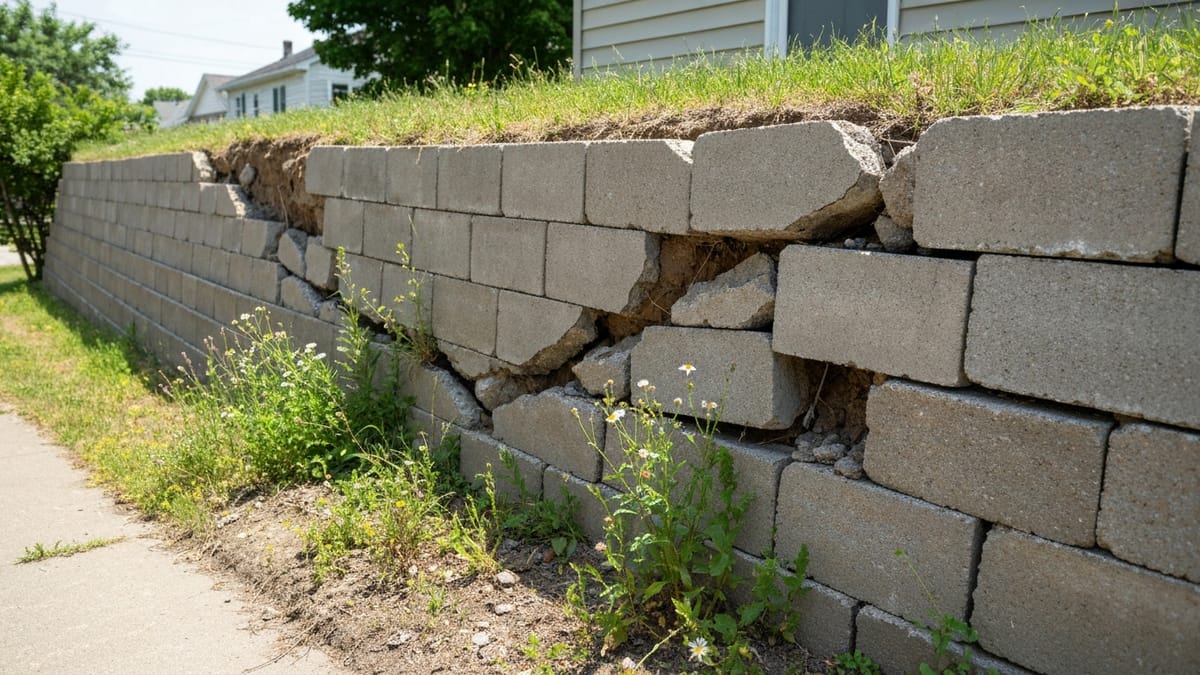
- Leaning or tilting: The whole wall rotates outward at the top. This is the classic sign of soil pressure exceeding what the wall was built to resist.
- Bulging: The wall face pushes out in the middle while the top and bottom stay put. Common in block and stone walls where the units shift under pressure.
- Cracking: Vertical or stair-step cracks in block and concrete walls signal the wall is being overstressed or the footing has moved.
- Footing or foundation failure: An undersized, shallow, or eroded footing lets the base of the wall settle or kick out. Everything above it follows.
- Drainage failure: No weep holes, a clogged drain line, or missing gravel backfill traps water behind the wall. This is the underlying issue behind most of the failures above.
- Frost heave: In cold climates, water in the soil freezes and expands, shoving the wall outward. Repeated freeze-thaw cycles wear a wall down over years.
Poor drainage sits underneath most of these. A wall can be built strong enough for dry soil and still fail because nobody planned for water. If you are seeing water pooling near the base or damp soil that never seems to dry, the drainage problem is worth understanding on its own, and our guide to water around the foundation covers how that same water dynamic damages both walls and foundations.
Retaining Wall Repair Cost by Method
The repair method depends entirely on the failure. Here is what each approach costs.
| Repair Method | Typical Cost | What It Fixes |
|---|---|---|
| Add weep holes | $500-$1,500 | Trapped water, early bulging |
| Install drainage line behind wall | $1,000-$3,000 | The root cause of most failures |
| Regrading and surface drainage | $500-$3,000 | Water flowing toward the wall |
| Helical tiebacks / anchors | $1,000-$3,000 per anchor | Leaning and bulging walls |
| Soil nails | $500-$1,000 per nail | Reinforcing a leaning wall face |
| Rebuild a section | $70-$125 per linear foot | Localized structural failure |
| Full rebuild | $70-$125 per linear foot | Widespread failure |
Drainage Repairs ($500-$3,000)
Because water is the root cause, drainage is often the first and cheapest fix. Drilling weep holes through an existing wall runs $500 to $1,500. Adding a proper drainage line, a perforated pipe in gravel behind the wall, costs $1,000 to $3,000 depending on length and access. This is the same French drain concept used around foundations, and our French drain cost guide breaks down the per-foot pricing that applies here too.
Drainage work alone will not straighten a wall that has already leaned. But paired with a structural fix, it stops the pressure that caused the problem, which is what keeps the repair from failing again.
Tiebacks and Helical Anchors ($1,000-$3,000 per anchor)
For a leaning or bulging wall that is still structurally sound, tiebacks are the standard fix. A steel anchor is drilled horizontally through the wall into stable soil behind it, then tensioned to pull the wall back and hold it. Helical tiebacks cost $1,000 to $3,000 per anchor installed, which works out to roughly $60 to $80 per linear foot of wall.
Anchor count depends on wall height and how hard the soil is pushing. A short garden wall might need two or three anchors; a tall, heavily loaded wall needs them spaced closer together, raising the per-foot cost.
Soil Nails ($500-$1,000 per nail)
Soil nails reinforce the soil mass behind the wall rather than anchoring to deep stable ground. They are shorter and more closely spaced than tiebacks, at $500 to $1,000 per nail. They suit walls where the failure is in the soil face rather than a deep-seated lean.
Rebuilding a Section vs. Full Rebuild ($70-$125 per linear foot)
When part of a wall has failed structurally, tearing out and rebuilding that section costs $70 to $125 per linear foot. A full rebuild uses the same per-foot rate across the whole length, so a 50-foot wall runs $3,500 to $6,250 and up depending on height and material. Rebuilding is the right call when the material has crumbled, the footing is gone, or the failure spans most of the wall.
Cost by Wall Material
Material affects both how a wall fails and what it costs to fix.
| Material | Typical Repair Range | Notes |
|---|---|---|
| Timber | $250-$1,100 | Rots and fails at the base; often rebuilt rather than patched |
| Concrete block / CMU | $300-$1,250 | Repairable by resetting or replacing units |
| Segmental block | $300-$1,500 | Interlocking units, often re-stacked with new drainage |
| Poured concrete | $500-$5,000 | Strong but crack repair and anchoring get expensive |
| Stone / boulder | $300-$1,600 | Re-setting stones is labor heavy |
These ranges cover localized repairs. A full material replacement scales with the per-linear-foot rebuild pricing above. Timber walls in particular tend to hit end of life and get rebuilt rather than repaired, because the rot that causes failure is usually widespread by the time it shows.
Per-Linear-Foot and Per-Square-Foot Pricing
Contractors price retaining wall work two ways. Per linear foot covers the length of the wall and is the common measure for rebuilds and anchoring, running $40 to $125 per linear foot depending on the work. Per square foot accounts for wall height and shows up on drainage and anchoring quotes: adding drainage to an existing wall runs $70 to $90 per square foot, and anchoring runs $60 to $80 per square foot of wall face.
A tall wall costs more per linear foot than a short one because there is more face area, more soil load, and more anchoring required. Always confirm which measure a quote uses so you can compare bids on the same basis.
When to Repair vs. Replace
The math usually comes down to how much of the wall is failing and whether the footing is sound.
Repair makes sense when:
- The lean is under about 2 inches and the structure is intact
- The failure is localized to one section
- The footing is still solid
- The core problem is drainage, which is fixable on its own
Replacement makes sense when:
- The wall is failing across most of its length
- The footing has failed or eroded away
- The material has deteriorated past saving, as with rotted timber
- Repair costs approach half the price of a full rebuild
A leaning wall under 2 inches with a good footing is a strong repair candidate at $1,000 to $4,000. Once it rotates past 2-3 inches or the base kicks out, rebuilding at $70 to $125 per linear foot is usually the more durable spend. For structural leaning and bulging problems specifically, our structural foundation repair service page covers the anchoring and stabilization methods in more detail.
What to Look for in a Quote
A complete retaining wall repair quote should spell out:
- The diagnosed cause, not just the symptom. If the quote fixes the lean but never mentions drainage, be skeptical. The water problem will come back.
- Drainage included or excluded. Confirm whether weep holes, a drain line, or regrading are part of the price or billed separately.
- Anchor count and spacing for tieback work, based on a wall assessment rather than a flat per-foot guess.
- Measurement basis, linear foot or square foot, so you can compare bids evenly.
- Backfill and compaction details on a rebuild, since a wall rebuilt over loose or saturated backfill fails again.
- Warranty on both materials and labor.
The most important thing to verify is that the contractor is treating the drainage as the root cause. A wall that leaned because water pushed it over will lean again if the water is not redirected, no matter how many anchors go in. The cheapest quote that skips drainage is rarely the cheapest repair over the life of the wall.