Low end
$2,000
Typical range
$2,000 - $30,000
High end
$30,000+
What a Sinkhole Is and Why Type Matters for Cost
A sinkhole forms when the ground underneath the surface loses support, usually because water dissolves or washes away soluble rock or soil below. When that support gives way, the ground above sinks or collapses into the void.
Not all sinkholes behave the same way, and the type affects both the repair method and the price.
- Cover-collapse sinkholes happen suddenly. The ground drops abruptly, sometimes overnight, and these are the ones that make the news. They tend to be the most damaging and the most expensive to fix because the collapse is often deep and structural.
- Cover-subsidence sinkholes develop slowly as the ground gradually settles into a soft void below. Damage builds over time, which can make early detection and a smaller repair possible.
- Solution sinkholes form where soluble rock is exposed at or near the surface and slowly dissolves, creating shallow depressions. These are frequently the least severe.
The takeaway is simple: a shallow surface depression is a filling job, while a deep void undermining a structure is an engineered stabilization job. The two live in completely different price brackets.
How Severity Drives the Cost
Severity, not the diameter of the hole at ground level, sets the budget. A sinkhole two feet across at the surface can be trivial or catastrophic depending on how deep the void runs and what sits above it.
Three questions determine the cost:
- Is a structure involved? A sinkhole in the middle of the yard is cheaper than one under the house. Once the home itself is affected, the project overlaps with foundation repair, and costs climb.
- How deep and how large is the void? Shallow voids can be filled from the surface. Deep voids require pressure grouting or piering that reaches down to stable ground.
- Is the sinkhole still active? A stabilized, dormant depression is a straightforward fix. A sinkhole that is still moving needs stabilization before any cosmetic repair, or the surface work simply fails again.
Repair Methods and What They Cost
Filling Small Depressions
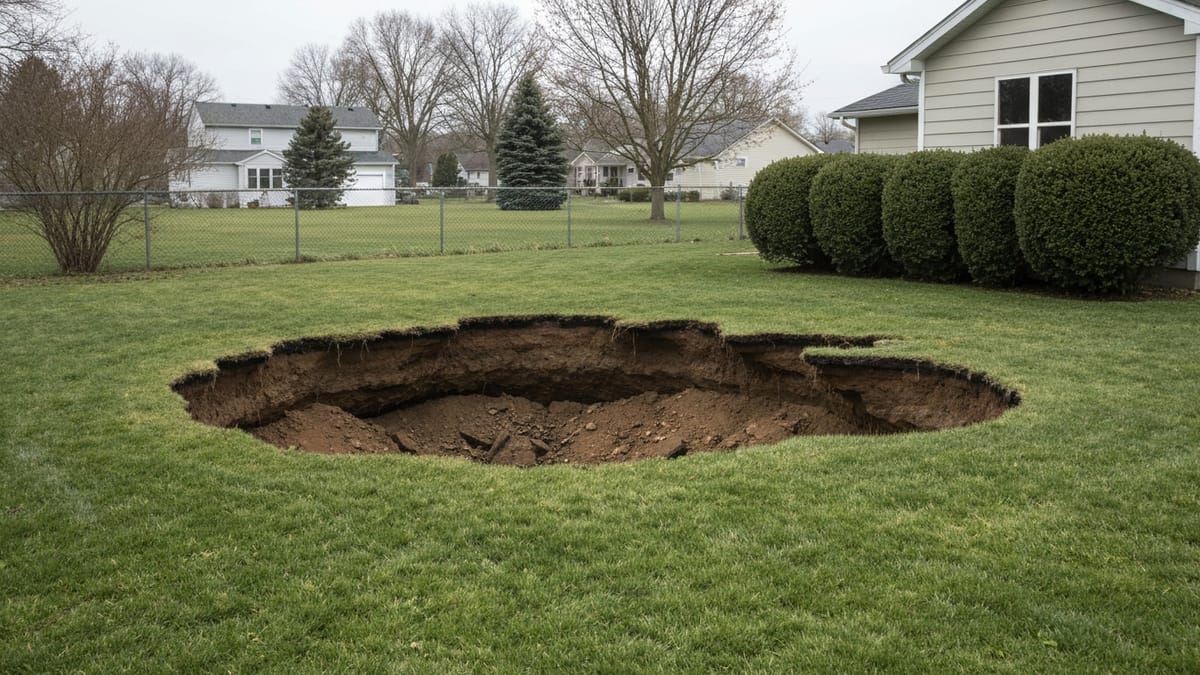
For a minor yard sinkhole with no structural involvement, the fix is to excavate loose material, fill the void with graded aggregate and soil, and compact it in layers. This runs roughly $500-$2,000. This only applies once an engineer or contractor has confirmed the depression is shallow and stable. Filling a live sinkhole from the top hides the problem instead of solving it.
Compaction and Chemical Grouting
When the void is deep and the soil below has lost load-bearing capacity, grouting rebuilds support from below. Compaction grouting pumps stiff cement grout under pressure to displace and compact weak soil. Chemical grouting uses injected resins or slurries to bind loose material.
For a structural sinkhole, grouting typically costs $10,000-$30,000 or more. The wide range reflects how unpredictable the ground is: nobody knows exactly how much grout the void will absorb until injection begins.
Underpinning and Piering When the House Is Affected
If the sinkhole has undermined the soil beneath your foundation, ground stabilization alone may not be enough. The foundation itself may need to be stabilized with piers driven or drilled down to competent bearing strata. This is the same work covered under foundation underpinning, and it commonly adds $10,000-$50,000 or more depending on the number of piers and how deep stable ground sits.
When the home is directly affected, the sinkhole repair and the foundation repair become one project. If you are seeing interior signs of movement, cracking, sticking doors, or a floor that has begun to slope, review foundation sinking causes and signs alongside the sinkhole work, because the two problems are connected.
Soil Stabilization and Drainage
Beyond grouting, some sites need broader soil stabilization or drainage improvements to keep water from re-triggering the void. Redirecting stormwater and repairing leaking utility lines can add several thousand dollars but often prevents a repeat sinkhole, which is far cheaper than a second full repair.
The Role of a Geotechnical Engineer
A geotechnical engineer or engineering geologist is the person who tells you what you are actually dealing with. Using soil borings, ground-penetrating testing, and analysis, they confirm whether the depression is a true sinkhole, map the void, and specify the correct repair and its scope.
This assessment costs roughly $1,500-$5,000. It is not an optional extra for anything beyond a shallow cosmetic dip. Skipping it leads to one of two expensive outcomes: paying to grout ground that never needed it, or filling a live sinkhole that keeps collapsing. If you intend to file an insurance claim, insurers typically require this geological testing before they will approve anything, so doing it first serves double duty.
Cost by Severity
| Severity | Situation | Typical Cost |
|---|---|---|
| Minor | Small, shallow, stable yard depression, fill and compact | $500-$2,000 |
| Moderate | Non-structural sinkhole affecting driveway, patio, or pool area | $5,000-$15,000 |
| Structural | Deep void requiring compaction or chemical grouting | $10,000-$30,000+ |
| Severe | Sinkhole under the house, grouting plus foundation piering | $10,000-$50,000+ |
| Assessment | Geotechnical engineering evaluation (add to any of the above) | $1,500-$5,000 |
Does Insurance Cover Sinkholes?
This is the question that changes the math, and the answer is often disappointing. Many standard homeowners policies exclude sinkholes and earth movement.
Florida is the clearest exception. State law requires insurers to include catastrophic ground cover collapse coverage in standard policies, but that coverage is narrow: it applies only when the ground collapses abruptly, the structure is damaged, and the home is rendered unsafe to occupy. Florida insurers must also offer broader sinkhole coverage as an endorsement, though in high-risk counties that add-on can cost as much as the base policy, and insurers usually require an inspection before agreeing to write it.
Outside Florida, coverage is inconsistent. Some states and insurers offer sinkhole endorsements; many exclude the peril entirely. The only reliable move is to read your specific policy and call your insurer before assuming anything. For the broader picture on foundation-related claims, see is foundation repair covered by insurance.
What to Look for in a Sinkhole Repair Quote
A serious quote should be built on an engineering assessment, not a walk-around estimate. Look for:
- A geotechnical report or reference to soil testing that justifies the repair method, not just a price to fill a hole
- The specific method proposed (fill and compact, compaction grouting, chemical grouting, piering) and why it fits your site
- Injection points or pier count and estimated depth for grouting or underpinning work
- How grout overruns are handled, since grout volume is genuinely hard to predict and open-ended billing can balloon a project
- Whether foundation repair is included or separate, if the house is affected
- Warranty terms on both the stabilization work and any structural repair
Be cautious of any contractor who offers to fill a sinkhole quickly and cheaply without engineering input. On a live sinkhole, that is money spent to postpone the real repair. If you are unsure whether the underlying ground problems are settlement, sinkhole activity, or something else, what causes foundation problems covers how these issues start.
Get the Assessment Before the Repair
The one rule that saves the most money on sinkhole work is to pay for the geotechnical assessment first. It is a small fraction of the total cost, and it is the only thing that tells you whether you are facing a $1,500 fill job or a $50,000 stabilization and underpinning project. Skipping it means guessing, and guessing wrong in either direction is expensive.