What Efflorescence Actually Is
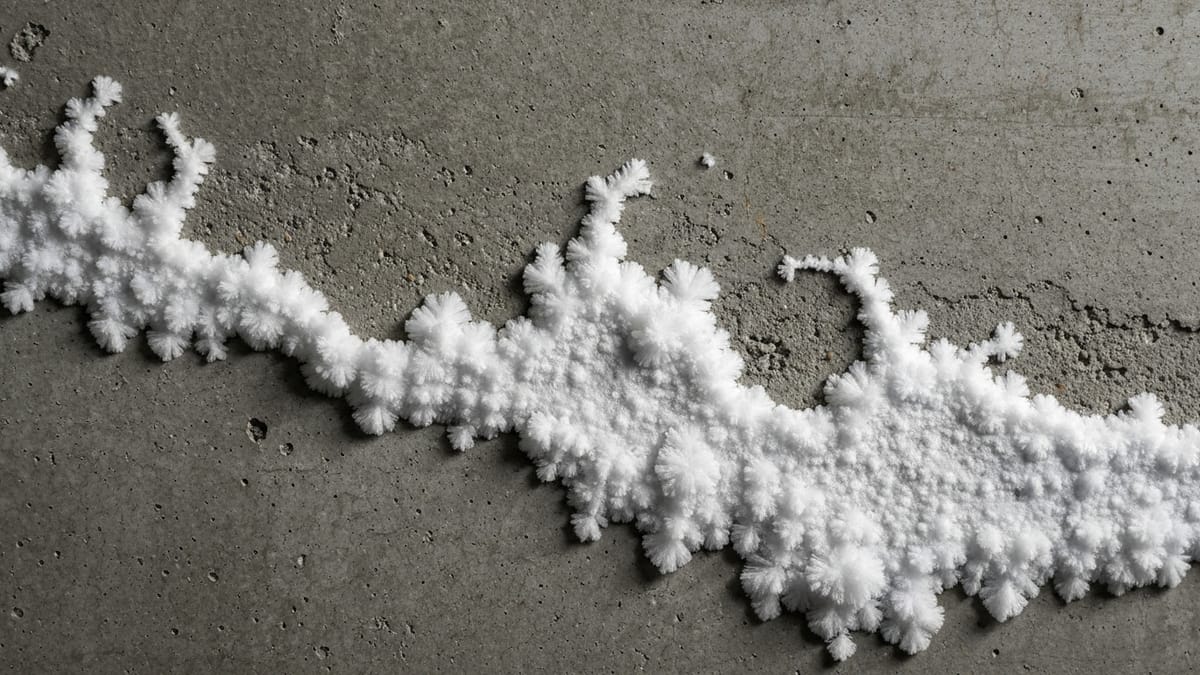
Efflorescence is the white or gray crystalline residue that shows up on basement walls, concrete floors, and masonry surfaces. The name comes from a Latin root meaning “to flower out,” which describes what it does: the deposit blooms outward from the surface of the material.
The mechanism is straightforward. Concrete, concrete block, brick, and mortar all contain soluble mineral salts. When water moves through the material, it dissolves those salts and carries them along. When that water reaches the surface and evaporates, it leaves the minerals behind as a fine crystalline crust. Over time, repeated cycles of wetting and evaporation build up the familiar chalky film.
The salts are typically calcium carbonate, along with sulfates and other minerals leached from the masonry itself. That is why the deposit is hard, mineral, and completely inorganic. It is essentially the same process that forms stalactites in a cave, just on a basement wall and a much smaller scale.
Why Efflorescence Matters
Here is the part homeowners often get wrong in both directions. Some panic and assume the wall is failing. Others dismiss it as a harmless stain and move on. Neither response is quite right.
Efflorescence itself is not structurally dangerous. It does not weaken the wall, it is not toxic, and scraping it off does not damage sound masonry. On its own, it is a cosmetic issue.
What matters is the message it carries. Efflorescence forms only where water is actively moving through the wall. You cannot get the deposit without moisture migration, so its presence is a reliable indicator that water is finding a path from the soil, through the foundation, and into your basement. That water path is the real concern.
Chronic moisture in a basement leads to problems that are genuinely serious over time:
- Mold growth on any organic material the dampness reaches, including framing, stored belongings, and drywall
- A musty, unhealthy indoor environment
- Corrosion of steel reinforcement embedded in the concrete
- Freeze-thaw damage in colder climates, where trapped water expands and spalls the masonry
- Gradual deterioration of the wall surface as salts and moisture cycle through it, which in severe cases ends in a crumbling foundation
So the honest framing is this: the efflorescence is harmless, but it is telling you something that is not. Read it as a signal, not as the disease.
Efflorescence vs Mold: How to Tell Them Apart
This is the single most useful distinction to get right, because the two look alike to a quick glance but demand completely different responses. Efflorescence is a cleaning-and-drainage issue. Mold is a moisture-and-remediation issue with health implications.
The differences come down to what the material is and how it behaves:
| Feature | Efflorescence | Mold |
|---|---|---|
| Composition | Mineral salt, inorganic | Living organism, organic |
| Color | White or gray | Black, green, brown, sometimes fuzzy white |
| Texture | Crystalline, powdery, gritty | Fuzzy, slimy, or spotty |
| Grows on | Concrete, block, brick, mortar | Wood, drywall paper, dust, organic film |
| Reaction to water | Dissolves and disappears | Stays put, may smear |
| Odor | None | Musty, earthy |
The water test is the fastest field check. Mist a small patch with plain water. Efflorescence, being a soluble salt, softens and dissolves. Mold does not. Combine that with location: if the growth is on bare masonry, it points to efflorescence, while growth on wood, paper, or a dusty painted surface points to mold. When there is any doubt, or the affected area is large, testing by a professional settles it.
How to Remove Efflorescence
Removing the visible deposit is the easy part. Work from the gentlest method up:
- Dry brushing. Start with a stiff nylon or wire brush on a dry wall. Much light efflorescence comes off with mechanical scrubbing alone, and dry brushing avoids adding water that redissolves the salts and drives them back into the surface.
- Water rinse. For what the brush leaves behind, rinse or scrub with plain water, then dry the area well so you are not feeding the next bloom.
- Diluted white vinegar. For stubborn buildup, a solution of white vinegar and water dissolves the mineral salts. Apply, let it work briefly, scrub, then rinse and dry.
- Masonry efflorescence cleaner. Heavy or recurring deposits respond to a purpose-made masonry cleaner. Follow the product directions, ventilate the space, and wear eye and skin protection.
One warning that saves people real money: do not seal over active efflorescence. Applying a sealer or waterproof paint while water is still moving through the wall traps the moisture and salts behind the coating. The result is bubbling, peeling, and flaking, usually within a season, plus a wall that is now harder to treat properly. Sealing has its place, but only after the water is stopped and the masonry has dried out.
The Real Fix Is Stopping the Water
Cleaning treats the symptom. If you want the efflorescence to stay gone, you have to cut off the water that creates it. In almost every case, that water is coming from outside, so the fix starts outside.
| Cause of the moisture | The fix |
|---|---|
| Soil graded flat or toward the house | Regrade so the ground slopes away from the foundation |
| Downspouts dumping at the wall | Extend downspouts several feet from the foundation |
| Clogged or missing gutters | Clean or add gutters so roof water is controlled |
| Saturated soil, high water table | Install a french drain or exterior drainage |
| Water pressure against the wall | Add interior or exterior basement waterproofing |
| Cracks or seepage points | Seal and address the specific entry path |
The general order of operations is to manage surface water first, since grading and gutter fixes are cheap and often solve the problem outright. If the moisture persists, the next step is dedicated drainage and basement waterproofing to manage the water that soil holds against the wall. You can weigh the investment against the basement waterproofing cost for your situation, but the payoff is a dry wall where efflorescence has no water to travel on.
When to Worry
By itself, efflorescence sits at the “monitor and address the moisture” end of the spectrum. It becomes more urgent when it shows up alongside signs that the wall is under real stress:
- Active leaks or standing water. Efflorescence plus visible water means a significant moisture problem, not just wicking.
- Spalling. Flaking, crumbling, or pitting concrete indicates freeze-thaw or salt damage that is degrading the masonry itself.
- Bowing or leaning walls. Horizontal cracks, inward bulging, or a wall that no longer runs true point to soil pressure that is a structural concern, not a cosmetic one.
Efflorescence next to any of those is a reason to have a foundation professional inspect the wall. On its own, it is a cue to find and stop the water before the ongoing dampness turns into the bigger issues that dampness eventually causes.